Global buyers are rethinking how water storage should perform in 2026. GRP Water Tanks offer corrosion resistance, modular construction, and practical service life across demanding environments. They can serve municipal networks, factories, farms, hotels, and emergency storage systems.
Yet, the right tank is not chosen by capacity alone. Climate, water quality, installation access, cleaning routines, and local engineering requirements all influence performance. A rooftop panel tank may suit a dense city site. A sectional tank may work better where transport access is limited. Cylindrical designs can simplify certain industrial installations. The details matter.
Dr. Elena Marquez, a composite-materials consultant with experience in water infrastructure, states, “A GRP tank succeeds when its material design matches the water, climate, and maintenance reality.”
That principle guides this 2026 overview. The following sections examine the top GRP Water Tanks types for global buyers, including sectional, one-piece, cylindrical, underground, and insulated models. Each type has strengths, limitations, and installation conditions worth checking before purchase.
Small errors become expensive.
A buyer may focus on a low quotation and overlook foundation tolerances, access clearance, or replacement-panel availability. That decision can create delays long after delivery. I have also seen specifications appear complete while omitting internal liners or hygiene testing requirements. This is not unusual, but it deserves reflection.
Reliable procurement requires more than comparing brochures. Buyers should verify resin quality, structural calculations, water-contact certification, warranty terms, and after-sales support. Supplier experience matters too. The best tank is not always the largest or cheapest. It is the one that remains safe, serviceable, and suitable for its actual environment.
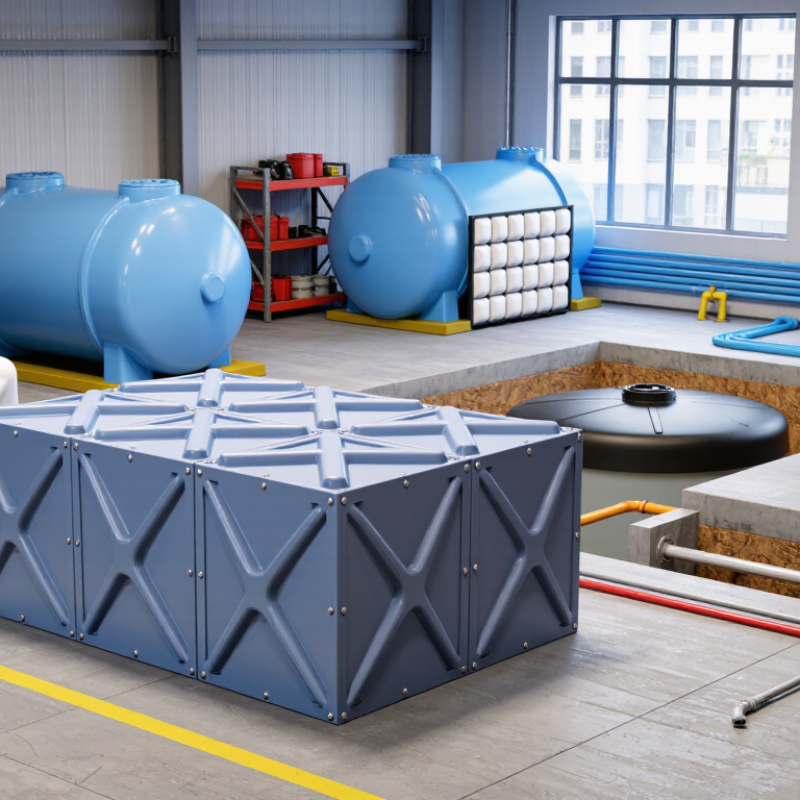
GRP water tanks are built from glass-fiber-reinforced plastic panels, commonly formed from sheet molding compound. Their layered structure combines resin for water resistance and glass fibers for mechanical strength. The panel pattern matters. Pressed ribs or textured surfaces can limit flexing when the tank is full. However, strength depends on panel thickness, support spacing, joint quality, and correct installation. A strong panel cannot rescue a weak foundation.
Most sectional tanks use overlapping panels, sealed joints, stainless or galvanized bolts, and internal stays. Food-contact applications require suitable materials and documented testing for the intended water use. A reliable design also includes a level base, access cover, screened vent, inlet, outlet, overflow, and drain. Insulation may be needed where freezing or high heat threatens water quality. UV protection deserves attention. Sunlight can gradually affect exposed resin surfaces, especially on poorly protected roofs.
From a buyer’s perspective, inspect drawings before comparing prices. Check dimensions, operating capacity, panel tolerances, sealant specifications, and replacement access. Ask for installation instructions and inspection records. In practice, small omissions cause large delays. Field inspections often find capacity emphasized while cleaning access and overflow routing are ignored. That mistake is easy to repeat. A careful review should match local climate, water chemistry, seismic risk, and maintenance skills. There is no maintenance-free GRP tank.
GRP water tanks combine glass fiber reinforcement with a resin matrix. Their light weight supports easier transport and faster installation. In 2026, sectional panel tanks remain common for schools, factories, hotels, and municipal buildings. Panels arrive separately and connect with bolts, seals, and internal supports. This format suits narrow access routes and changing storage capacities. Extra panels can sometimes expand the tank later.
One-piece molded tanks offer a compact alternative for homes, farms, and small commercial sites. Their smooth internal surfaces reduce places where sediment may collect. Horizontal tanks fit low-clearance areas, while vertical tanks use floor space efficiently. Underground GRP tanks protect water from sunlight and temperature changes. However, installers must confirm soil conditions, buoyancy risks, and external loading. Installation mistakes can damage even a well-made tank.
Experienced buyers should check resin suitability, potable-water approval, panel thickness, joint design, and test records. UV protection matters for outdoor tanks. Access covers, overflow pipes, drain points, and level indicators also require practical inspection. Local water regulations may differ between countries, so documentation should match the project location. A specification sheet can look complete but still hide unclear assumptions. Rechecking dimensions, working temperature, and foundation details prevents expensive corrections. No single type fits every site.
2026 Top GRP Water Tank Types for Global Buyers
GRP tank designs serve different water storage needs through shape, capacity, and installation method. Sectional panel tanks suit schools, factories, hospitals, and apartment buildings. Their panels travel easily and connect on site. This matters when roads are narrow or shipping space is limited. A typical project may use a roof-level tank for daily supply and a larger ground tank for reserve storage.
One-piece molded tanks provide a compact option for farms, small businesses, and remote facilities. They arrive ready for placement, reducing assembly work and possible joint errors. Underground GRP tanks preserve usable land and protect water from sunlight. However, installers must check soil pressure, groundwater, access space, and lifting conditions. A tank that fits the drawing may still fail during delivery.
Material selection also changes performance. Food-grade inner surfaces support potable water applications, while UV-resistant outer layers help exposed tanks last longer. Engineers should review water temperature, chemical contact, wind loads, seismic risk, and cleaning access before choosing a design. Hydrostatic testing, panel inspection, gasket checks, and foundation verification should be recorded before use.
Small details matter. A narrow manhole can make maintenance frustrating. Poor ventilation can create hygiene concerns. I have seen designs optimized for price, then revised after installation because the drain location was inconvenient. Reliable buyers compare total service life, not only the initial quotation, and confirm local compliance documents before production.
How GRP tank designs serve different water storage needs
Sectional panel tanks are commonly selected for medium-to-large commercial, municipal, and industrial storage because their capacity can be expanded on site. One-piece molded tanks suit smaller residential and light-commercial installations, while cylindrical above-ground and underground GRP tanks are often used where site layout, corrosion resistance, or buried storage is important. The capacity bands shown are typical planning ranges; final sizing depends on demand, local codes, fire-water requirements, structural loads, and installation conditions.
Global buyers should compare GRP water tanks through standards, materials, and verified production data. The WHO/UNICEF Joint Monitoring Programme reported that 2.2 billion people lacked safely managed drinking water in 2022. Demand is growing, but specification errors remain common.
EN 13280 covers glass-reinforced plastic sectional tanks for water storage, while AWWA D121 addresses fiberglass pressure tanks. These references help buyers check panel strength, joint design, dimensional tolerance, and testing methods. For potable water, request certification under NSF/ANSI/CAN 61 or an equivalent national requirement. Not every “food-grade” claim is independently verified.
Material selection also affects service life. Compare resin type, glass-fiber content, UV protection, liner construction, and fastener corrosion resistance. A tank exposed to strong sunlight needs more than a thick outer finish. UNESCO’s World Water Development Report 2024 states that agriculture represents about 70% of global freshwater withdrawals, making leakage control especially important in large storage systems. Ask for hydrostatic test records, bolt-torque procedures, and batch traceability. Factory experience matters here.
The overlooked detail is installation quality. Uneven foundations can distort panels and stress seals. Sometimes, the cheapest tank becomes expensive after one poor assembly. That deserves reflection.
| GRP Water Tank Type | Construction and Typical Use | Indicative Project Capacity | Common Materials | Global Standards and Certifications to Check | Key Quality Factors | Typical Advantages | Important Limitations |
|---|---|---|---|---|---|---|---|
| Pressed SMC Panel Tank | Factory-molded square or rectangular panels assembled on site with bolted or flanged joints. Common for potable water, fire water, process water, and commercial or municipal storage. | Approximately 1–5,000 m³ per tank, subject to panel geometry, structural design, and site conditions. | Glass-fiber-reinforced polyester SMC panels Food-contact liner Stainless-steel or hot-dip-galvanized fasteners may be used. | EN 13280 where applicable; NSF/ANSI/CAN 61, BS 6920, WRAS, or AS/NZS 4020 for drinking-water contact, depending on the destination market. | Panel thickness and rib design; resin-to-glass ratio; joint gasket quality; bolt torque control; internal liner integrity; dimensional accuracy; hydrostatic testing. | Modular transportation; rapid installation; flexible capacity; damaged panels can generally be replaced individually. | More joints than a monolithic tank; workmanship at connections is critical; not intended for pressurized service. |
| GRP Sectional Flanged Tank | Prefabricated GRP sections or panels joined with external flanges, internal fasteners, or proprietary-style connection details. Used where access is restricted or factory handling is preferred. | Approximately 10–2,000 m³ for many building and infrastructure projects; final capacity is design-specific. | GRP laminate Isophthalic or equivalent resin EPDM or approved potable-water gasket materials. | EN 13280 where applicable; potable-water-contact approval such as NSF/ANSI/CAN 61, BS 6920, WRAS, or AS/NZS 4020 as required by the authority having jurisdiction. | Flange flatness; laminate thickness; glass orientation; gasket compression; bolt material; leak testing; UV protection for exposed installations. | Compact delivery; suitable for rooftops, basements, and narrow access routes; relatively simple field assembly. | Flange alignment and gasket installation can affect leakage performance; access and maintenance clearances must be planned. |
| Filament-Wound GRP Tank | Cylindrical tank manufactured by winding resin-impregnated glass fibers around a mandrel. Often used for water treatment, chemical dosing support, filtration systems, and vertical storage. | Commonly from several hundred liters to approximately 100 m³; larger sizes require specialized engineering and transportation planning. | E-glass fibers Vinyl ester or polyester resin Optional corrosion-resistant internal barrier. | Project-specific structural design; potable-water-contact approval where applicable; chemical compatibility should be verified against the stored medium. | Fiber winding angle; laminate continuity; nozzle reinforcement; internal corrosion barrier; wall thickness; pressure and vacuum design limits. | Good strength-to-weight ratio; smooth internal surface; fewer field joints; efficient for vertical cylindrical configurations. | Transportation limits can restrict size; not every filament-wound vessel is suitable for potable water or vacuum service. |
| Hand-Laminated or Spray-Up GRP Tank | Composite tank fabricated by manually placing or spraying glass reinforcement and resin. Used for custom shapes, retrofit work, small batches, and applications requiring non-standard fittings. | Usually project-specific, commonly below approximately 100 m³; capacity depends heavily on fabrication capability and design. | Chopped-strand mat Woven roving Polyester, vinyl ester, or epoxy resin selected according to water chemistry. | Verify conformity to the project specification and applicable local regulations; potable-water-contact testing is essential for drinking-water use. | Laminate uniformity; void content; cure quality; fiber wet-out; resin batch traceability; internal surface finish; dimensional and leak inspection. | Flexible design; economical for prototypes and customized geometries; fittings can be integrated during fabrication. | Quality may vary significantly with process control and operator skill; field repairs require qualified procedures. |
| GRP Underground Storage Tank | Buried cylindrical or sectional tank designed for underground installation and soil or groundwater conditions. Used for potable water, rainwater, fire reserves, and non-hazardous process water. | Approximately 5–500 m³ is common for many projects; larger capacities require detailed geotechnical and structural design. | Stiffened GRP laminate Corrosion-resistant barrier Reinforced base, ribs, saddles, or anchoring system as required. | Applicable local structural and installation codes; EN 13280 where relevant; potable-water-contact approval for drinking-water applications. | External pressure and buckling resistance; groundwater uplift; soil bearing capacity; anchorage; manway strength; backfill specification; watertightness. | Saves above-ground space; protects stored water from sunlight; reduced visual impact and temperature fluctuation. | Installation errors can cause deformation or flotation; inspection and future access are more difficult than for above-ground tanks. |
| GRP Fire-Water Storage Tank | Above-ground or underground tank dedicated to fire-protection reserves. The required volume and retention time are determined by the fire system design and local fire authority. | Project-specific; often tens to thousands of cubic meters depending on hazard classification and fire-flow demand. | Structural GRP panels or laminate Approved potable or non-potable liner as required; corrosion-resistant supports and fittings. | Local fire codes and insurer requirements; relevant tank structural standards; potable-water-contact standards only when the stored water is also intended for drinking use. | Usable reserve volume; suction outlet arrangement; vortex protection; overflow capacity; level monitoring; emergency access; seismic and wind design. | Corrosion resistance; relatively low maintenance; can be configured for dedicated or combined water reserves. | Fire authority approval is critical; tank sizing cannot be selected from capacity alone; suction and refill performance must be checked. |
| GRP Potable-Water Tank | A GRP tank specifically selected and documented for treated drinking water. May be sectional, flanged, molded, or filament-wound depending on capacity and installation requirements. | From small building tanks to municipal-scale installations; project capacity must follow demand, storage, and local code calculations. | Low-migration resin system Approved liner or gel coat Non-toxic gaskets, sealants, coatings, and fittings. | NSF/ANSI/CAN 61; BS 6920; WRAS; AS/NZS 4020; or another recognized national drinking-water-contact scheme accepted in the target market. EN 13280 may apply to the tank construction. | Certificate scope; extraction or migration test results; material traceability; cleanability; opaque cover; screened vents; hygienic internal surfaces; disinfection procedure. | Lightweight compared with many metallic alternatives; resistant to rust; suitable for modular installation. | Certification must cover the actual resin, liner, gasket, and fitting combinations; approval in one country may not be accepted in another. |
| GRP Chemical- or Process-Water Tank | Tank engineered for industrial water, mildly corrosive liquids, wastewater, or treatment-system service. Chemical compatibility must be evaluated for concentration, temperature, and exposure time. | From small dosing-support tanks to several hundred cubic meters; larger units require detailed process and structural review. | Vinyl ester Chemical-resistant barrier Polyester or epoxy systems may be selected for compatible duties. | Applicable chemical-service, environmental, pressure, and structural requirements; potable-water certifications are not automatically relevant. | Resin chemical-resistance chart; liner thickness; temperature rating; nozzle reinforcement; venting; overflow containment; inspection after curing. | High corrosion resistance when correctly specified; lower weight than many metal tanks; wide range of custom configurations. | Incorrect resin selection can lead to rapid degradation; tank is generally for atmospheric service unless specifically engineered otherwise. |

International buyers should select a GRP water tank by duty, not appearance. The 2023 WHO/UNICEF Joint Monitoring Programme reported that 2.2 billion people lacked safely managed drinking water in 2022. That pressure makes dependable storage important, especially where supply interruptions are common.
Start with the water. Potable water may require certified resin, an approved liner, and traceable hygiene testing. Irrigation water usually prioritizes capacity, ultraviolet exposure, and easy maintenance. The UN World Water Development Report 2024 notes that agriculture accounts for about 70% of global freshwater withdrawals.
Agricultural users may therefore need large sectional tanks, while buildings often suit compact panel tanks.
Check the site carefully. Measure foundation strength, wind exposure, seismic risk, access routes, and local temperature ranges. A sectional GRP tank is easier to transport and expand. A molded tank can simplify installation but may limit volume.
Ask for panel thickness, resin type, bolt protection, gasket material, and test records. ISO 24513 emphasizes risk-based management across water services, not just equipment quality.
Do not trust a brochure alone. One weak assumption can become a costly leak. I would also request a filled-load inspection plan, because installation errors often undermine otherwise sound tank design.