Choosing the right SMC Tank is not simply a matter of comparing prices, volumes, or delivery dates. Global buyers face different climates, water standards, installation conditions, and maintenance expectations. A tank designed for a coastal hotel may not suit a cold-region factory. Small details matter.
The need is substantial. The WHO and UNICEF Joint Monitoring Programme reported that 2.2 billion people lacked safely managed drinking water in 2022. Meanwhile, the United Nations World Water Development Report 2024 identified rising demand, climate pressure, and uneven infrastructure as continuing water-management challenges. These findings make storage reliability more important for commercial, industrial, agricultural, and public projects. An SMC Tank can offer modular construction, corrosion resistance, and easier transportation. However, these advantages depend on correct material selection, joint design, foundation preparation, and quality control.
Water-policy expert Professor Asit K. Biswas has stated, “There is no water crisis in the world. There is a crisis of poor management of water resources.” His observation also applies to tank purchasing. The cheapest quotation may become expensive after leakage, replacement panels, or difficult servicing. Buyers should examine panel thickness, resin quality, food-contact suitability, testing records, warranty terms, and compliance with relevant standards, such as EN 13280 or local requirements. Ask for evidence, not promises. It is also wise to confirm seismic, wind, temperature, and foundation calculations before ordering.
No single specification fits every market. This article explains how global buyers can evaluate an SMC Tank supplier, compare technical documents, and avoid decisions based only on catalog images or attractive prices. Some assumptions may need revision. That is part of responsible procurement.
Choosing an SMC tank starts with water demand, not the tank catalogue. Measure daily use from occupied buildings, production lines, irrigation, and emergency reserves. Then identify peak demand during mornings, shift changes, or dry seasons. A 100-cubic-metre tank may look adequate, yet recover too slowly after a two-hour peak. Use actual meter records where possible. Estimates are useful, but they are still estimates.
Count the safety margin carefully. Oversizing raises costs and may increase water residence time. Undersizing causes pressure problems and frequent refilling. A demand model should include future occupancy, planned expansion, cleaning cycles, and incoming water reliability. Ask a qualified hydraulic engineer to verify the calculation and connection layout. Small errors become expensive underground.
Site conditions decide whether the selected capacity works for 30 years. Check wind, snow, seismic exposure, ultraviolet intensity, salt air, and seasonal temperature swings. A coastal site needs corrosion-resistant supports and protected fittings. A cold region may require insulation, heating controls, or freeze protection. Confirm foundation bearing capacity, drainage, delivery access, panel handling, and maintenance clearance. The tank must suit the route to site, not only the final footprint. Review potable-water contact requirements and structural calculations against applicable local standards. A neat spreadsheet cannot replace a site survey. Nor can a long warranty correct poor installation or neglected inspections.

Choosing the right SMC tank starts with its modular footprint. A 1×1 metre panel grid simplifies transport, assembly, and future expansion. However, it can restrict access routes inside compact plant rooms.
The WHO/UNICEF JMP 2023 update reported that 2.2 billion people lacked safely managed drinking water in 2022. Reliable storage therefore matters, especially where supply interruptions are common. Do not select capacity alone. Check panel counts, inlet positions, outlet clearance, cleaning access, and maintenance space. A three-metre service route may be impossible through a narrow doorway. Measure the route, not only the tank room.
Roof design needs equal attention. Water weighs about 9.81 kN per cubic metre. A 4×3 metre tank holding 12 cubic metres creates roughly 118 kN of water load, excluding panels, framing, and seismic effects. Snow and wind actions should follow the applicable design code, such as EN 1991-1-3, EN 1991-1-4, or ASCE 7-22. A 1.5 kPa snow load over 12 square metres adds 18 kN before safety factors. Support beams may need reinforcement. Guessing is risky.
Tips: Measure twice. Draw the route first. Confirm local roof loads with a qualified engineer. Leave a removable panel near valves and inspection points. I have seen workable layouts fail because a replacement panel could not pass the doorway. That detail is easy to miss.
| Typical Application | Panel Arrangement (1×1 m Panels) |
Nominal Tank Size (L × W × H) |
Approximate Working Volume | Minimum Access Route | Recommended Service Clearance | Liquid Load on Supporting Roof or Slab | Key Selection Consideration |
|---|---|---|---|---|---|---|---|
| Small building water reserve | 2 × 2 × 1 panel courses | 2 m × 2 m × 1 m | 4 m³ (approximately 4,000 L) |
Clear opening of at least 1.1 m wide and 2.1 m high for personnel and panel handling | At least 600 mm around accessible sides; keep valve and manhole areas unobstructed | Approximately 9.8 kN/m² for 1 m water depth, excluding tank self-weight, supports, pipework, and seismic effects | Suitable where the available footprint is compact and the supporting structure has been checked for a concentrated tank load |
| Residential or light commercial supply | 3 × 3 × 1.5 panel courses | 3 m × 3 m × 1.5 m | 13.5 m³ (approximately 13,500 L) |
Clear route of at least 1.2 m wide; confirm lift, stair, corridor, and turning restrictions before delivery | 600–900 mm around inspection, inlet, outlet, and overflow connections | Approximately 14.7 kN/m² for 1.5 m water depth, excluding tank self-weight, supports, pipework, and dynamic effects | A practical mid-range configuration when a square footprint provides balanced access and pipe routing |
| Commercial or institutional storage | 4 × 4 × 2 panel courses | 4 m × 4 m × 2 m | 32 m³ (approximately 32,000 L) |
Clear route of at least 1.5 m wide where multiple panels, frames, and installation tools must pass | 900 mm preferred on service sides; provide safe access to the roof, manhole, valves, and overflow | Approximately 19.6 kN/m² for 2 m water depth, excluding tank self-weight, supports, pipework, and seismic effects | Check structural deflection, waterproofing, drainage, access protection, and emergency overflow capacity |
| Large process or fire-water reserve | 5 × 5 × 2 panel courses | 5 m × 5 m × 2 m | 50 m³ (approximately 50,000 L) |
Clear route of at least 1.5 m; verify whether panels can be moved horizontally or require mechanical lifting | 900–1,000 mm around primary service sides; maintain unobstructed inspection access | Approximately 19.6 kN/m² for 2 m water depth, excluding tank self-weight, supports, pipework, and fire-system loads | Often better at ground level unless the roof has been specifically designed for the full liquid load and support reactions |
| Restricted-height installation | 4 × 4 × 3 panel courses | 4 m × 4 m × 3 m | 48 m³ (approximately 48,000 L) |
Clear route of at least 1.5 m; confirm the maximum panel diagonal, door height, and internal turning radius | 900 mm minimum at service sides; provide safe working access above the tank where required | Approximately 29.4 kN/m² for 3 m water depth, excluding tank self-weight, supports, pipework, and wind or seismic effects | Higher tanks increase hydrostatic pressure and overturning demand; structural and anchorage design require project-specific review |
| Low-profile roof or plant-room installation | 6 × 4 × 1 panel course | 6 m × 4 m × 1 m | 24 m³ (approximately 24,000 L) |
Clear route of at least 1.2 m; confirm that the long footprint can pass through the building without panel rotation issues | 600–900 mm at inspection and connection sides; maintain access to roof drainage outlets | Approximately 9.8 kN/m² for 1 m water depth, excluding tank self-weight, supports, pipework, and maintenance loads | Lower height reduces hydrostatic pressure, but the larger footprint must still be checked against roof beams, slabs, penetrations, and drainage falls |
For global buyers, SMC tank selection should begin with material performance, not price. Sheet molding compound combines thermoset resin with chopped glass fibers. This structure provides useful stiffness while keeping panel weight manageable. However, fiber orientation and molding quality can change real performance. Request tensile, flexural, and water-absorption results tested under ASTM methods. Check the panel thickness, reinforcement percentage, and joint design. A strong panel can still fail at a poorly sealed flange.
Corrosion resistance depends on the resin system and stored liquid. The NACE IMPACT study estimated global corrosion costs at about $2.5 trillion annually, equal to 3.4% of global GDP. For industrial or coastal sites, ask for chemical compatibility data, not broad claims such as “corrosion-proof.” Acidic water, disinfectants, and saline air may affect resins differently. UV stability also needs evidence. ISO 4892-3 supports accelerated fluorescent-UV testing for plastics, but laboratory exposure cannot perfectly reproduce every climate. Look for color retention, surface cracking, and strength results after UV cycling. Dark panels may heat faster under direct sun. That detail is easy to overlook. I would also question suppliers offering only short indoor-use data. Real installations face thermal movement, dust, rain, and maintenance errors. A careful buyer compares tested performance with the tank’s actual location, liquid, and service life.
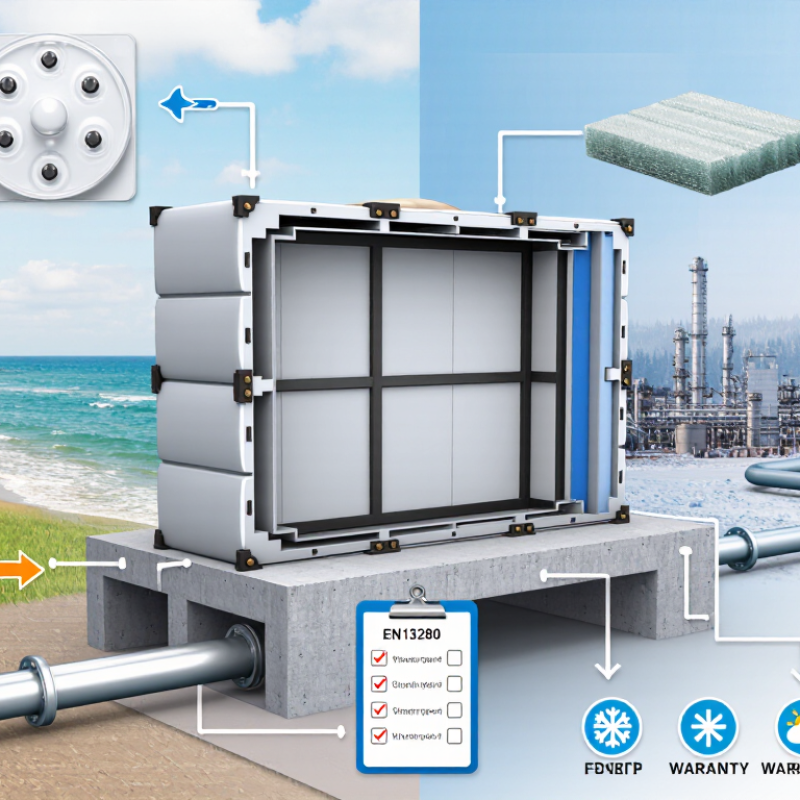
For global buyers, an SMC tank should be selected through documented compliance, not appearance alone. EN 13280 is relevant to certain thermoplastic tanks for above-ground storage of non-dangerous aqueous liquids, so confirm that its scope matches your tank design. Check the certificate number, testing body, product dimensions, and intended application. A generic reference to the standard is not enough.
For potable water projects, NSF/ANSI 61 verification helps confirm that wetted materials meet health-effect requirements. Ask for the exact resin, liner, gasket, and fitting details covered by the approval. WRAS approval may be important for installations connected to the UK water supply. However, WRAS status can depend on the specific component and use. It should not be treated as worldwide approval. Certificates need current dates, clear model references, and traceable reports.
ISO 9001 shows that the manufacturer operates a quality management system. It does not automatically prove tank safety or drinking-water compliance. Review production records, inspection points, pressure or leakage tests, and batch traceability. Request drawings before ordering. Small differences matter. During supplier audits, buyers often focus on certificates and overlook installation conditions, wall thickness, or transport damage. That is a practical weakness. Compliance must follow the complete supply chain, from raw materials to final inspection. When documents conflict, pause the purchase and request written clarification from the certification body or manufacturer.
Global Compliance Verification: EN 13280, NSF/ANSI 61, WRAS, and ISO 9001
This comparison shows the primary scope of each reference. A value of 1 means the reference directly addresses that compliance area, while 0 means it is not the primary purpose. EN 13280 focuses on specified thermoplastic storage tanks, NSF/ANSI 61 addresses health effects from drinking-water system components, WRAS supports UK water-fittings acceptance, and ISO 9001 specifies quality-management-system requirements rather than tank certification.
Choosing an SMC tank requires more than comparing factory prices. Freight can change the decision quickly. UNCTAD’s Review of Maritime Transport 2023 states that ships carry over 80% of global merchandise trade by volume. However, destination delivery may still include port handling, customs clearance, inland haulage, and crane access. Request landed-cost quotations, not only FOB prices. Measure the packed volume carefully.
Installation also deserves a realistic allowance. Include the foundation, lifting equipment, local labor, water testing, and site drainage. The World Bank’s Logistics Performance Index 2023 highlights major differences in shipment reliability between markets. Delays can increase equipment rental costs. Small errors become expensive. A narrow road may require smaller lifting equipment or additional transfers.
For 30-year total cost of ownership, use this structure: purchase, freight, installation, inspections, cleaning, seal replacement, repairs, and eventual disposal. ISO 15686 service-life guidance supports planning maintenance across an asset’s complete life, rather than reacting to failures. Discount future costs using a documented local rate. Inflation assumptions should be tested, not trusted blindly. A spreadsheet should compare at least three scenarios: low, expected, and difficult access. In my experience, buyers often underestimate cleaning labor and roof-access safety. They also assume zero component replacement. That is optimistic. Record inspection intervals, spare-part availability, and water-quality requirements before approval. A cheaper tank can become costly when maintenance access is poor.